Melody Beat - Offline Music
- 4.0
- Rating
- 10.00M
- Installs
- Free
- Price

 Analysis by App-foxy
When I try a new music app, I want to reach my own songs quickly, understand the controls without a tutorial, and keep listening when the connection becomes unreliable. Melody Beat - Offline Music is built around that straightforward idea. It is a free Music & Audio app from Flores, aimed at people who want their personal listening routine to work during travel, exercise, or quiet moments away from a strong signal.
My first impression is that it makes more sense as a practical local music player than as a replacement for a full streaming service. That distinction matters. If you already have music available on your device and want a simple way to play it, the app has an appealing purpose. If you expect a huge online catalog, discovery tools, podcasts, artist radio, or a social layer, you should look elsewhere.
Getting from installation to a useful first listen
I’d use this section to focus on the small checks that make a first listen feel dependable: confirm the music you want is on the device, try a familiar track, and make sure the sound reaches your usual headphones or speaker. That approach also gives you a useful baseline before changing folders or adding more songs.
You May Also Like

 Blood Strike: 2.5 Anniversary
Blood Strike’s Loadouts Turn Every Drop Into a Tactical Gamble
A close look at Blood Strike’s custom loadouts: how fast access to signature weapons reshapes its battle royale rhythm, rewards preparation, and narrows the gap between fights.

 Pandora - Music & Podcasts
Pandora’s Music Is Easy to Start, but Harder to Recover
Pandora’s strength is its low-effort path from a seed to a station. Its weak spot is how much confidence it asks you to place in connection, setup, and quiet recovery.

 8 Ball Pool
 Is Built on Rivalries, Rematches, and Routine
A close look at the rivalries, rematches, shared routines, and unanswered safety questions that turn a quick pool match into a persistent mobile community.

 Samsung Music
’s Quiet Strength Is Playing What You Already Own
Its reach comes less from spectacle than from dependable access to a personal library. That simplicity is both the app’s strongest retention engine and its ceiling.

 AccuWeather: Weather Radar
AccuWeather Review: A Quick, Clear Forecast for Everyday Decisions
For everyday plans, the best forecast is the one you can understand quickly. AccuWeather makes rain timing, radar, and local conditions easy to act on, with a few trade-offs.

 Hill Climb Racing
Why Hill Climb Racing Still Turns Crashes Into One More Run
A tiny car, a bumpy hill and one more upgrade: Hill Climb Racing keeps resurfacing because its simple chaos makes every near-miss feel personal.
More From Our News Desk



What to expect before opening it
Melody Beat is available at no cost and is rated for Everyone, which makes it easy to consider for a shared family device or for someone who does not want another subscription. It has reached over five million installs and holds a 4.2 average from around four thousand ratings, so it is not an obscure experiment that only a handful of listeners have tried. The app was released on August 22, 2025, and version 1.1.3 is the version I would look for when checking that I am using the current release.
The minimum operating-system requirement is Android 8.0. That is useful for people keeping an older phone in service as a travel player, although compatibility alone does not guarantee that every device will behave identically. Older hardware may have its own storage, battery, or background-playback quirks. I would install it before a long trip rather than waiting until I am already at the airport or on a train.
The most important expectation is that the app’s value depends on the music already available to you. “Offline” should be read as listening without an active connection, not as a promise that the application supplies music on demand. I would first make sure the tracks I want are stored locally and playable on the phone. That small check prevents the most common disappointment: opening a player away from home and discovering that the desired songs were never downloaded or transferred in the first place.
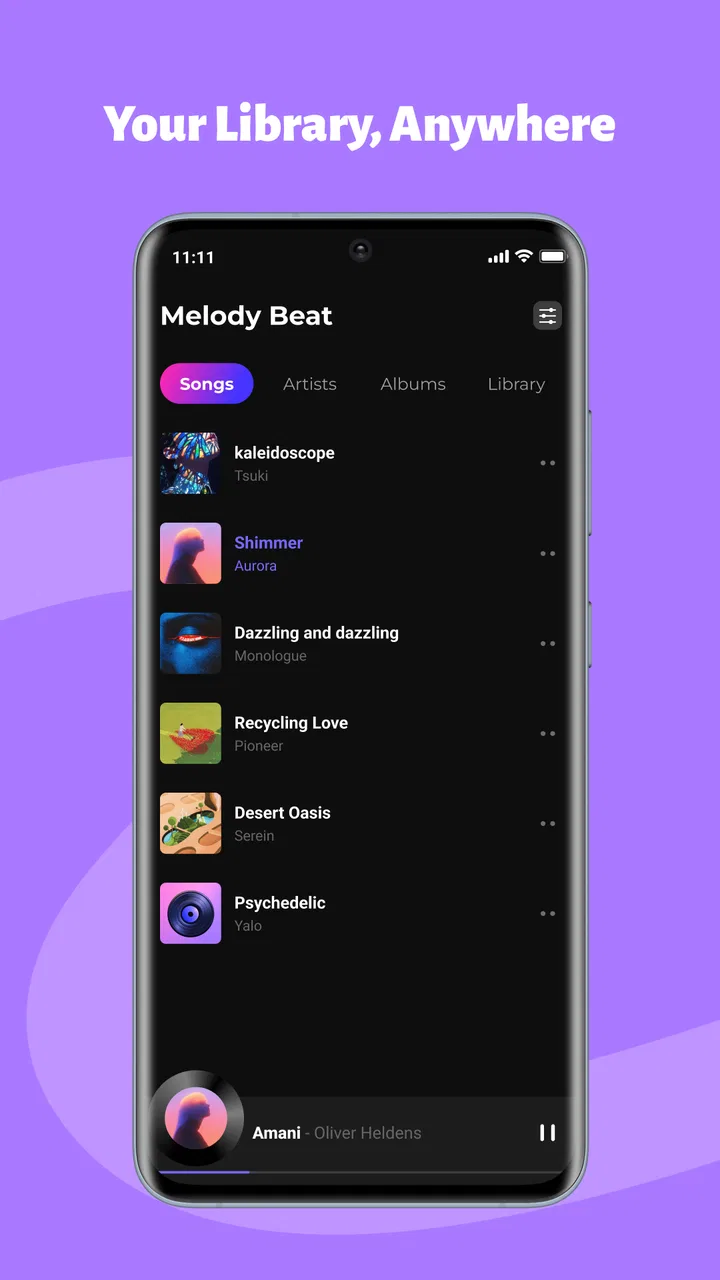
For a first-time user, the best mental model is a compact control room for existing audio. You are not signing up for a new music ecosystem. You are organizing a dependable listening session around files or tracks that your device can already access. That makes the app particularly suitable for commutes, workouts in places with weak reception, flights, and backup phones with a carefully selected music collection.
The first setup is more important than it looks
After installing Melody Beat, I would begin by checking whether the app can see the music collection I actually intend to use. Rather than tapping through every screen randomly, I would prepare a small test group: a few familiar songs with different lengths and, if possible, different file types already stored on the device. The goal is not to build a complete library immediately. It is to confirm that the app finds the content and that playback behaves as expected.
This test-first approach is one of the most useful habits with any offline player. It separates an app problem from a library problem. If one song appears while another does not, the issue may be where the file is stored or how it is recognized, rather than the play button itself. If a track appears but will not play, testing another known-good file can tell you whether the problem is isolated. I prefer discovering that at home, where I can adjust my collection, instead of during a workout when I have no patience for troubleshooting.
Once the music is visible, I would create a practical listening order in my head before pressing play. For a journey, that might mean choosing relaxed tracks first and more energetic songs later. For exercise, I would keep the selection short enough that I can start it without repeatedly handling the phone. This is a small workflow improvement, but it changes the experience: the app becomes something I prepare once and then leave alone.
It is also worth checking the phone’s everyday audio behavior. Connect the headphones or speaker you normally use, lower the volume before starting, and test pausing and resuming. If you use wired headphones, try the physical controls. If you use a wireless device, confirm that the audio route is correct. These checks are not glamorous, yet they answer the questions that matter most in real use: can I start a song quickly, can I stop it safely, and can I hear it through the device I brought with me?
Your first successful action should be deliberately simple
For a reassuring first result, I would choose one familiar song and play it from start to finish for a few minutes. I would avoid beginning with a large library or a complicated listening plan. A single successful track confirms that the app can locate your content, begin playback, and produce sound through your preferred output. Once that works, adding more music feels like a gradual improvement rather than a guessing game.
My next test would be to turn off the connection temporarily and start another local track. This is the meaningful moment for an offline music app. It tells you whether your chosen collection is genuinely ready for the situation in which you bought into the idea. I would not wait for a flight or a remote trail to perform this check. A short test at home gives you confidence and reveals whether you need to transfer more music before leaving.
For workouts, I would keep the first session intentionally low-maintenance. Select a set of songs before putting the phone away, start playback, and use the simplest controls when needed. The advantage here is not just saving mobile data. It is reducing interruptions. A local collection can be more predictable than a stream when you are moving through areas with unstable reception, and that predictability is often more valuable than discovering a new song in the middle of an exercise session.
For travel, I would prepare two listening groups: one for the main journey and one as a fallback. The fallback can be a smaller selection of tracks you know well. This is a practical trade-off. A large library offers variety, but a compact backup makes it easier to recover if one folder is not recognized or one file behaves unexpectedly. Melody Beat works best when you treat offline listening as preparation rather than as something that happens automatically.
Where first-time users may become confused
The word “offline” can create the wrong expectation. Melody Beat is useful when music is already available to the device, but it should not be confused with a service that downloads any song from the internet simply because you searched for it. If you want a large catalog, automatic recommendations, or one-tap access to newly released music, a streaming platform is the better match. This app’s strength is control over a prepared collection, not online discovery.
Another possible source of confusion is the difference between seeing a song in a file manager and seeing it inside a player. A track may exist somewhere on the phone but still require the app to recognize or scan its location. If a song is missing, I would first check the storage location, confirm that the file is complete, and test with another track. I would not immediately assume that the entire app is broken.
Playback interruptions can also come from the phone rather than from Melody Beat. Battery-saving behavior, audio focus from another application, a disconnected headset, or a speaker switching inputs can all make a simple player seem unreliable. My troubleshooting order would be deliberately boring: check the volume, confirm the output device, pause other audio apps, restart the track, and then test with a different song. This avoids wasting time changing several things at once.
There is a related organizational issue that becomes more noticeable as your collection grows. A local player is only as tidy as the music you give it. Inconsistent song names, duplicate files, and scattered folders make any offline library harder to browse. I would clean up the collection before blaming the interface. Keeping a travel folder, a workout folder, and a general listening folder can make the first screen far more useful than importing every audio file on the phone.
I would also resist judging the app by the standards of a streaming service. Streaming apps usually win at search, discovery, synchronized libraries, and recommendations. Melody Beat is more attractive when the priorities are independence from a connection, a personal collection, and a direct route from stored song to playback. Comparing the two without considering that difference leads to an unfair conclusion.
Small workflows that make the app more useful
One non-obvious advantage of preparing music locally is that you can design listening around the environment instead of around an algorithm. Before a flight, I might choose a calm sequence that does not require attention. Before a run, I would select tracks with a consistent mood and avoid anything likely to make me reach for the phone. The app becomes part of a routine: prepare the audio once, then protect your attention later.
A second useful habit is the “known-good” test. I keep one or two tracks that have already played successfully and use them whenever I change headphones, move music to a different folder, or prepare a new device. If those tracks work, I can investigate new files separately. This is especially helpful for someone who transfers music from several sources, because it prevents a single troublesome file from making the whole library seem unreliable.
A third trade-off concerns variety versus certainty. With streaming, I can usually discover something new whenever I feel restless. With Melody Beat, I need to choose the collection in advance, but I gain a more predictable session. For long journeys, I would combine both approaches when possible: use the offline player for the core listening plan and keep online discovery for places where connectivity is dependable. That way, a weak signal does not ruin the entire trip.
A fourth practical tip is to treat the phone’s available storage as part of the listening plan. I would not fill the device blindly. I would keep the collection focused on music I genuinely expect to hear, especially on a phone also used for photos and work files. A smaller, organized library is easier to maintain and quicker to test than a huge archive that contains several copies of the same album.
Who should use it, and who should skip it
I would recommend Melody Beat to someone who already owns or stores music on an Android phone and wants a free way to play it without depending on a live connection. It also makes sense for travelers who prefer to prepare audio before leaving, people exercising in areas with inconsistent reception, and listeners who value a personal collection over endless recommendations. Its Everyone rating and broad device compatibility make it approachable for a wide range of users.
I would be less enthusiastic for someone whose main goal is music discovery. If your ideal experience starts with searching for an artist you have never heard, follows with curated suggestions, and continues across several devices through a synchronized account, a conventional streaming service will probably feel more complete. The same is true if you expect built-in access to a broad online catalog rather than a player for music you have already made available locally.
I would also skip it as a sole solution if your collection is still entirely online. The app cannot make an unprepared library feel prepared. In that situation, the first step is obtaining music through a legitimate source and storing it on the device in a way your player can use. Only then does the offline workflow become meaningful.
How it compares with familiar alternatives
Compared with a full streaming app, Melody Beat trades catalog size and discovery for a more focused offline routine. That is not automatically better or worse. A streaming service is more convenient when you want variety immediately, while this player is more dependable when you have already decided what to hear and do not want a connection to be part of the equation.
Compared with a phone’s basic built-in audio player, the appeal is the clearer purpose suggested by the app’s name and positioning: a dedicated place for music sessions rather than a general tool hidden among system applications. Whether that feels like a major improvement depends on how well your current player handles local tracks. If the built-in option already gives you the organization and controls you need, Melody Beat may be a second player rather than an essential replacement.
Compared with heavyweight music managers, its likely advantage is approachability. A newcomer does not need to begin by learning a complicated library system. The downside of that simplicity is that listeners with advanced tagging, elaborate synchronization, or deep collection-management needs may want a more specialized application. I would choose Melody Beat for quick, prepared playback, not for managing a professional-sized archive.
What I would do after the first successful session
After confirming that one song plays offline, I would build a small collection for the next real situation rather than importing everything. A travel set, a workout set, or an evening set gives the app a clear job. I would then test that group without a connection and with the headphones I plan to use. This two-stage preparation is more reliable than assuming that every track will behave identically.
If a track is missing, I would investigate the file and its location before replacing the application. If playback stops, I would check the audio output and other apps before concluding that the player is at fault. These simple habits make the experience less frustrating and help identify the rare problem that actually needs a different solution.
Flores has positioned this release as a practical Music & Audio app, and version 1.1.3 gives first-time users a clear reason to try it: keep personal music ready for moments when online listening is inconvenient. I like that focused purpose. I would not install it expecting a complete streaming universe, but I would consider it a sensible companion for a prepared local library.
My final recommendation is straightforward: try it with a small group of music, test that group with the connection disabled, and judge it by how smoothly it supports your own routine. Melody Beat - Offline Music is at its best when certainty matters more than discovery. For travel, workouts, and offline listening, that can be exactly the right balance. For users who want constant catalog access and automatic exploration, another category of app will serve them better.
FAQs for Melody Beat - Offline Music
01What is Melody Beat - Offline Music, and how does it work?
Melody Beat - Offline Music is a feature-rich music app designed for users who enjoy listening to music without needing an internet connection. It allows you to download your favorite tracks directly to your device for offline playback. The app offers a user-friendly interface, easy navigation, and supports various audio formats, ensuring a seamless music experience.
02Can I create playlists in Melody Beat - Offline Music?
Yes, Melody Beat - Offline Music allows users to create custom playlists. You can organize your favorite tracks into playlists to suit different moods or activities. The app also provides options to edit and rearrange songs within your playlists, offering a personalized listening experience tailored to your preferences.
03Is Melody Beat - Offline Music compatible with all devices?
Melody Beat - Offline Music is compatible with both Android and iOS devices. It supports a wide range of smartphones and tablets, ensuring that you can enjoy your music without any compatibility issues. The app is regularly updated to enhance performance and maintain compatibility with the latest operating systems.
04Does Melody Beat - Offline Music support multiple audio formats?
Yes, the app supports a variety of audio formats including MP3, AAC, WAV, and more. This flexibility allows users to enjoy high-quality music playback without worrying about format compatibility. Whether you're downloading tracks from different sources or converting them, Melody Beat ensures they play smoothly.
05How does the offline feature work in Melody Beat - Offline Music?
The offline feature allows you to download music directly to your device, so you can listen without an internet connection. Simply select the tracks you want, download them, and access them anytime through the app’s library. This is particularly useful for traveling or when you have limited data access.
Pros
- No internet required for playback.
- User-friendly interface with easy navigation.
- Wide variety of music genres available.
- Customizable playlists for personalized listening.
- High-quality audio output.
Cons
- Limited song library compared to online apps.
- No option for music streaming.
- Ads can be intrusive at times.
- No social sharing features.
- Updates are less frequent.

Melody Beat - Offline Music
Gallery